ORBIT-EO ideas
You are given a task to integrate an existing React component in the codebase
The codebase should support:
- shadcn project structure
- Tailwind CSS
- Typescript
If it doesn’t, provide instructions on how to setup project via shadcn CLI, install Tailwind or Typescript.
Determine the default path for components and styles.
If default path for components is not /components/ui, provide instructions on why it’s important to create this folder
Copy-paste this component to /components/ui folder:
halftone-nebula.tsx
"use client"

import * as React from "react"

/**
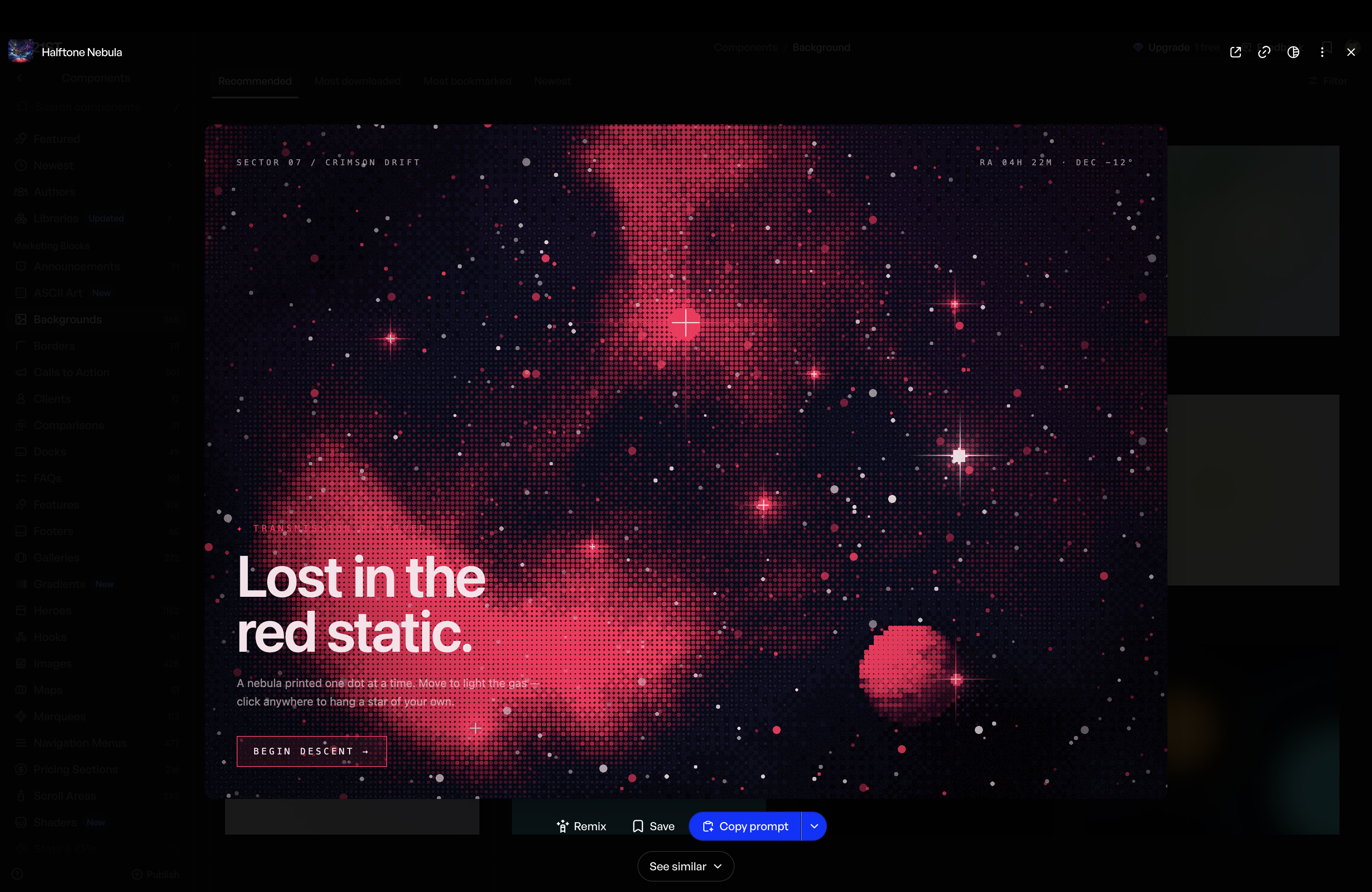
 * Halftone Nebula — a pixel-art night sky printed in dots.
 *
 * One full-screen fragment pass. The nebula is domain-warped fbm sampled once
 * per pixel cell, quantised with an ordered Bayer dither, then printed as a
 * halftone: every cell is a flat square of the dim ramp with a round dot of the
 * bright ramp on top, the dot's radius driven by density. Where the gas is thin
 * the dots shrink to a faint mesh; where it is thick they grow past the cell
 * and merge into solid pixel blotches — the same trick a risograph uses.
 *
 * On top: three parallax layers of hashed pixel stars, a halftone planet, and
 * cross-shaped sparkle stars whose spikes are drawn at one CSS pixel so they
 * stay needle-thin against the chunky grid. The pointer is a lamp that parts
 * the gas and swells the dots under it; a click drops a new sparkle and sends a
 * shock ring through the cloud.
 *
 * Self-contained: raw WebGL2, React is the only import. No textures, no image
 * assets, no CSS file. The canvas sizes itself from its own box, never the
 * window, and releases every GL object on unmount.
 */

export type NebulaParams = {
  // the grid
  /** CSS px per pixel cell. Everything snaps to this. */
  pixel: number
  /** Dot radius, in cells, where the gas is empty / densest. >0.5 merges dots. */
  dotMin: number
  dotMax: number
  /** Quantisation steps before dithering. Fewer reads more like pixel art. */
  levels: number
  // the gas
  scale: number
  warp: number
  drift: number
  density: number
  threshold: number
  softness: number
  /** The luminous river of gas that sweeps across the frame. */
  band: number
  bandAngle: number
  bandOffset: number
  bandWidth: number
  haze: number
  // stars
  stars: number
  twinkle: number
  starDrift: number
  sparkles: number
  seed: number
  spikeWidth: number
  // planet
  planet: boolean
  planetX: number
  planetY: number
  planetRadius: number
  // the pointer
  parallax: number
  lens: number
  lensRadius: number
  lensPush: number
  rippleSpeed: number
  // post
  speed: number
  vignette: number
  grain: number
  // palette, dark to bright
  voidColor: string
  hazeColor: string
  duskColor: string
  wineColor: string
  crimsonColor: string
  hotColor: string
  starColor: string
}

export const NEBULA_DEFAULTS: NebulaParams = {
  pixel: 6,
  dotMin: 0.12,
  dotMax: 0.56,
  levels: 7,

  scale: 1.7,
  warp: 1.5,
  drift: 0.035,
  density: 0.5,
  threshold: 0.54,
  softness: 0.5,
  band: 0.5,
  bandAngle: 1.05,
  bandOffset: 0.42,
  bandWidth: 0.34,
  haze: 0.8,

  stars: 1,
  twinkle: 1.4,
  starDrift: 1.2,
  sparkles: 9,
  seed: 11,
  spikeWidth: 1,

  planet: true,
  planetX: 0.26,
  planetY: 0.36,
  planetRadius: 0.075,

  parallax: 1,
  lens: 0.55,
  lensRadius: 170,
  lensPush: 0.3,
  rippleSpeed: 420,

  speed: 1,
  vignette: 0.5,
  grain: 0.035,

  voidColor: "#050309",
  hazeColor: "#161a38",
  duskColor: "#3b1646",
  wineColor: "#5c0d31",
  crimsonColor: "#c01245",
  hotColor: "#ff1f5a",
  starColor: "#f6e2e8",
}

/** Overlays on the defaults. Named for the sky, not the numbers. */
export const NEBULA_PRESETS: Record<string, Partial<NebulaParams>> = {
  crimson: {},
  ultraviolet: {
    hazeColor: "#10183f", duskColor: "#2a1a5e", wineColor: "#3d1478",
    crimsonColor: "#7b2cf0", hotColor: "#c77dff", starColor: "#eef0ff",
    bandAngle: 2.2, bandOffset: 0.3, planetX: 0.74, planetY: 0.3, seed: 4,
  },
  abyssal: {
    voidColor: "#02060a", hazeColor: "#0a1f2e", duskColor: "#0d2f3f", wineColor: "#0a4453",
    crimsonColor: "#0f8f9f", hotColor: "#3ff2e0", starColor: "#e4fffb",
    band: 0.5, bandAngle: -0.4, bandOffset: -0.2, planetX: 0.7, planetY: 0.66, seed: 23,
  },
  solar: {
    voidColor: "#070403", hazeColor: "#231208", duskColor: "#3d1a07", wineColor: "#6e2406",
    crimsonColor: "#d8520c", hotColor: "#ffb020", starColor: "#fff3d6",
    warp: 1.9, band: 0.72, bandAngle: 0.4, planetRadius: 0.1, seed: 5,
  },
  phosphor: {
    voidColor: "#020502", hazeColor: "#08170c", duskColor: "#0c2412", wineColor: "#0e3d18",
    crimsonColor: "#1f9d3a", hotColor: "#6dff7a", starColor: "#e6ffe8",
    pixel: 5, levels: 5, planet: false, sparkles: 6, seed: 31,
  },
}

const MAX_SPARKS = 16
const MAX_RIPPLES = 4

type Kind = "f" | "i" | "b" | "c"
type Slot = [keyof NebulaParams, Kind]

/** Which parameters reach the shader, and as what. `c` is a hex colour. */
const UNIFORMS: Slot[] = [
  ["pixel", "f"], ["dotMin", "f"], ["dotMax", "f"], ["levels", "f"],
  ["scale", "f"], ["warp", "f"], ["drift", "f"], ["density", "f"],
  ["threshold", "f"], ["softness", "f"],
  ["band", "f"], ["bandAngle", "f"], ["bandOffset", "f"], ["bandWidth", "f"], ["haze", "f"],
  ["stars", "f"], ["twinkle", "f"], ["starDrift", "f"], ["spikeWidth", "f"],
  ["parallax", "f"], ["lens", "f"], ["lensRadius", "f"], ["lensPush", "f"], ["rippleSpeed", "f"],
  ["vignette", "f"], ["grain", "f"],
  ["voidColor", "c"], ["hazeColor", "c"], ["duskColor", "c"], ["wineColor", "c"],
  ["crimsonColor", "c"], ["hotColor", "c"], ["starColor", "c"],
]

const uName = (k: string) => "u" + k[0].toUpperCase() + k.slice(1)
const glslType = (kind: Kind) => (kind === "c" ? "vec3" : kind === "i" || kind === "b" ? "int" : "float")
const declare = (slots: Slot[]) =>
  slots.map(([k, kind]) => "uniform " + glslType(kind) + " " + uName(k) + ";").join("
")

const VERT = `#version 300 es
void main(){
  vec2 p = vec2(float((gl_VertexID << 1) & 2), float(gl_VertexID & 2));
  gl_Position = vec4(p * 2.0 - 1.0, 0.0, 1.0);
}`

const FRAG = `#version 300 es
precision highp float;
uniform vec2 uRes;
uniform float uDpr;
uniform float uTime;
uniform vec2 uPointer;
uniform float uPointerOn;
uniform vec2 uLook;
uniform int uSparkCount;
uniform vec4 uSpark[${MAX_SPARKS}];
uniform vec4 uSparkB[${MAX_SPARKS}];
uniform vec4 uRipple[${MAX_RIPPLES}];
uniform vec4 uPlanet;
${declare(UNIFORMS)}
out vec4 frag;

float hash12(vec2 p){
  vec3 p3 = fract(vec3(p.xyx) * 0.1031);
  p3 += dot(p3, p3.yzx + 33.33);
  return fract((p3.x + p3.y) * p3.z);
}
float vnoise(vec2 p){
  vec2 i = floor(p), f = fract(p);
  f = f * f * (3.0 - 2.0 * f);
  float a = hash12(i), b = hash12(i + vec2(1.0, 0.0));
  float c = hash12(i + vec2(0.0, 1.0)), d = hash12(i + vec2(1.0, 1.0));
  return mix(mix(a, b, f.x), mix(c, d, f.x), f.y);
}
float fbm(vec2 p){
  float s = 0.0, a = 0.5;
  mat2 r = mat2(0.8, -0.6, 0.6, 0.8);
  for (int i = 0; i < 5; i++) { s += a * vnoise(p); p = r * p * 2.03 + 17.1; a *= 0.5; }
  return s / 0.96875;
}
float bayer4(vec2 c){
  vec2 m = mod(c, 4.0);
  int i = int(m.x) + int(m.y) * 4;
  int b[16] = int[16](0, 8, 2, 10, 12, 4, 14, 6, 3, 11, 1, 9, 15, 7, 13, 5);
  return (float(b[i]) + 0.5) / 16.0;
}
vec3 ramp(float d, vec3 haze){
  vec3 c = mix(uVoidColor, haze, smoothstep(0.0, 0.22, d));
  c = mix(c, uWineColor, smoothstep(0.18, 0.44, d));
  c = mix(c, uCrimsonColor, smoothstep(0.42, 0.72, d));
  return mix(c, uHotColor, smoothstep(0.7, 0.96, d));
}
vec2 shift(float depth){
  return floor(uLook * uParallax * depth * 28.0);
}

// Density of the gas at a CSS-pixel position: x = density, y = haze, z = tone.
vec3 field(vec2 pos, vec2 resCss){
  float minSide = min(resCss.x, resCss.y);
  vec2 uv = (pos - 0.5 * resCss) / minSide;
  vec2 p = uv * uScale + uLook * uParallax * 0.05;

  vec2 toP = pos - uPointer;
  float lamp = exp(-dot(toP, toP) / (uLensRadius * uLensRadius)) * uPointerOn;
  p += toP / minSide * lamp * uLensPush * uScale;

  float ring = 0.0;
  for (int i = 0; i < ${MAX_RIPPLES}; i++) {
    vec4 r = uRipple[i];
    float age = uTime - r.z;
    if (r.w <= 0.0 || age < 0.0 || age > 2.4) continue;
    vec2 dv = pos - r.xy;
    float dist = length(dv);
    float w = 14.0 + age * 26.0;
    float k = exp(-pow((dist - age * uRippleSpeed) / w, 2.0)) * (1.0 - age / 2.4) * r.w;
    ring += k;
    p += dv / max(dist, 1.0) * k * 0.12;
  }

  float t = uTime * uDrift;
  vec2 q = vec2(fbm(p + vec2(0.0, t * 0.7)), fbm(p + vec2(5.2, 1.3) - t * 0.5));
  float n = fbm(p + uWarp * q + vec2(t * 0.4, -t * 0.25));

  vec2 dir = vec2(cos(uBandAngle), sin(uBandAngle));
  float along = dot(uv, dir);
  float across = dot(uv, vec2(-dir.y, dir.x)) - uBandOffset - 0.22 * sin(along * 2.3 + t * 3.0) - (q.x - 0.5) * 0.35;
  float river = exp(-across * across / (uBandWidth * uBandWidth));

  float raw = n + river * uBand * 0.5 + (uDensity - 0.5) * 0.5;
  float d = smoothstep(uThreshold, uThreshold + uSoftness, raw);
  d = clamp(d + lamp * uLens * 0.45 + ring * 0.55, 0.0, 1.0);

  for (int i = 0; i < ${MAX_SPARKS}; i++) {
    if (i >= uSparkCount) break;
    vec4 s = uSpark[i];
    vec4 b = uSparkB[i];
    float grow = smoothstep(0.0, 0.6, uTime - s.w);
    float dist = length(pos - s.xy - shift(1.2));
    d += exp(-dist / max(b.w * 2.2 * (1.0 + b.z * 0.6), 1.0)) * 0.55 * grow;
  }

  float hz = smoothstep(0.25, 0.75, n + river * 0.25) * uHaze;
  float tone = fbm(p * 0.45 + vec2(11.0, -3.0) + t * 0.2);
  return vec3(clamp(d, 0.0, 1.0), hz, tone);
}

void main(){
  vec2 resCss = uRes / uDpr;
  vec2 css = gl_FragCoord.xy / uDpr;
  float px = max(uPixel, 1.0);
  vec2 cell = floor(css / px);
  vec2 cellC = (cell + 0.5) * px;
  vec2 f = fract(css / px) - 0.5;
  float L = max(uLevels, 2.0);
  float dith = bayer4(cell);

  // ---- the gas, printed as a halftone ---------------------------------------
  vec3 g = field(cellC, resCss);
  vec3 hazeCol = mix(uHazeColor, uDuskColor, smoothstep(0.38, 0.62, g.z));
  float dq = clamp(floor(g.x * L + dith) / L, 0.0, 1.0);
  float hq = floor(g.y * 3.0 + dith) / 3.0;
  vec3 bg = mix(uVoidColor, hazeCol, hq * 0.7);
  bg = mix(bg, ramp(dq * 0.7, hazeCol) * 0.42, smoothstep(0.0, 0.3, dq));
  float r = mix(uDotMin, uDotMax, sqrt(dq));
  float dotMask = step(length(f), r);
  vec3 dotCol = dq < 0.01 ? mix(uVoidColor, hazeCol, 0.35 + hq * 0.5) : ramp(min(dq + 0.1, 1.0), hazeCol);
  vec3 col = mix(bg, dotCol, dotMask);

  // ---- pixel stars, three parallax depths ------------------------------------
  vec3 starAcc = vec3(0.0);
  float starA = 0.0;
  for (int l = 0; l < 3; l++) {
    float fl = float(l);
    float depth = 0.3 + fl * 0.4;
    float gpx = px * (l == 2 ? 2.0 : 1.0);
    vec2 sp = css + shift(depth) + vec2(0.0, floor(uTime * uStarDrift * depth));
    vec2 id = floor(sp / gpx);
    vec2 fr = fract(sp / gpx) - 0.5;
    float prob = uStars * (l == 0 ? 0.009 : l == 1 ? 0.014 : 0.01);
    float h = hash12(id + fl * 71.3);
    if (h > 1.0 - prob) {
      float h2 = hash12(id * 1.7 + 3.1 + fl);
      float tw = 0.45 + 0.55 * (0.5 + 0.5 * sin(uTime * uTwinkle * (0.6 + h2 * 2.5) + h2 * 40.0));
      float rad = l == 2 ? 0.42 : 0.26 + h2 * 0.22;
      float m = step(length(fr), rad);
      vec3 c = (l == 0 || h2 > 0.82) ? uStarColor : uHotColor;
      starAcc = max(starAcc, c * m * tw);
      starA = max(starA, m * tw);
    }
  }
  col = mix(col, starAcc / max(starA, 1e-3), starA * (1.0 - g.x * 0.55));

  // ---- the planet, same halftone, lit from the upper left --------------------
  if (uPlanet.w > 0.5) {
    vec2 pc = uPlanet.xy + shift(0.8);
    float R = uPlanet.z;
    vec2 dc = cellC - pc;
    if (length(dc) < R) {
      vec2 n2 = dc / R;
      float z = sqrt(max(1.0 - dot(n2, n2), 0.0));
      float lit = clamp(dot(vec3(n2, z), normalize(vec3(-0.45, 0.55, 0.7))), 0.0, 1.0);
      float surf = fbm(vec2(n2.x * 1.4 + uTime * 0.015, n2.y * 4.2) * 1.6 + 9.0);
      float pd = clamp(lit * 1.05 - smoothstep(0.55, 0.75, surf) * 0.45 * (1.0 - lit * 0.5) + 0.05, 0.0, 1.0);
      float pq = floor(pd * L + dith) / L;
      vec3 pbg = mix(mix(uVoidColor, uWineColor, 0.35), uWineColor, pq);
      float pr = mix(0.2, 0.62, sqrt(pq));
      vec3 pdot = ramp(min(pq * 0.85 + 0.25, 1.0), hazeCol);
      col = mix(pbg, pdot, step(length(f), pr));
    }
  }

  // ---- sparkle stars: chunky core, needle spikes -----------------------------
  vec2 sh = shift(1.2);
  for (int i = 0; i < ${MAX_SPARKS}; i++) {
    if (i >= uSparkCount) break;
    vec4 s = uSpark[i];
    vec4 b = uSparkB[i];
    float age = uTime - s.w;
    if (age < 0.0) continue;
    float grow = smoothstep(0.0, 0.55, age) * (1.0 + 0.3 * exp(-age * 3.0) * sin(age * 13.0));
    float tw = 0.84 + 0.16 * sin(uTime * uTwinkle * 1.7 + b.y);
    float flare = 1.0 + b.z * 0.6;
    float reach = s.z * grow * tw * flare;
    float core = b.w * grow * flare;
    vec3 tint = mix(uHotColor, uStarColor, b.x);
    vec2 c = s.xy + sh;
    vec2 d = css - c;
    float th = uSpikeWidth * 0.5 + 0.25;
    float hx = step(abs(d.y), th) * pow(max(1.0 - abs(d.x) / max(reach, 1.0), 0.0), 1.1);
    float vy = step(abs(d.x), th) * pow(max(1.0 - abs(d.y) / max(reach, 1.0), 0.0), 1.1);
    // A short second pair of spikes, turned 45deg, only on the big ones.
    vec2 rd = vec2(d.x + d.y, d.x - d.y) * 0.7071;
    float diag = step(0.5, core / px - 1.5) * 0.45 * max(
      step(abs(rd.y), th) * pow(max(1.0 - abs(rd.x) / max(reach * 0.22, 1.0), 0.0), 2.0),
      step(abs(rd.x), th) * pow(max(1.0 - abs(rd.y) / max(reach * 0.22, 1.0), 0.0), 2.0));
    col = mix(col, tint, clamp(max(max(hx, vy), diag), 0.0, 1.0));
    // The core snaps to the cell grid, so it reads as a pixel-art disc.
    float hp = px * 0.5;
    vec2 dcell = (floor(css / hp) + 0.5) * hp - (floor(c / hp) + 0.5) * hp;
    float disc = step(length(dcell), core);
    float glow = exp(-length(d) / max(core * 1.4, 1.0)) * (1.0 - disc);
    col += tint * glow * 0.35;
    col = mix(col, tint, disc);
    float cross = max(step(abs(d.y), th) * step(abs(d.x), core * 0.85),
                      step(abs(d.x), th) * step(abs(d.y), core * 0.85));
    col = mix(col, uStarColor, cross * disc * 0.9);
  }

  // ---- post -----------------------------------------------------------------
  vec2 vu = gl_FragCoord.xy / uRes - 0.5;
  col *= 1.0 - uVignette * smoothstep(0.35, 0.95, length(vu * vec2(uRes.x / uRes.y, 1.0) * 1.1));
  col += (hash12(floor(css) + fract(uTime) * 91.0) - 0.5) * uGrain;
  frag = vec4(max(col, vec3(0.0)), 1.0);
}`

/**
 * One sparkle star. Position is 0..1 of the box (y up); `reach` and `core` are
 * fractions of the box's shorter side, so the sky scales with its container.
 */
export type Sparkle = {
  x: number
  y: number
  reach: number
  core: number
  /** 0 = the accent colour, 1 = the pale star colour. */
  tint: number
  phase: number
  /** Seconds on the component clock when it was born; it grows in from there. */
  born: number
  user: boolean
}

// #region sky
/** A tiny seeded PRNG, so the same `seed` always hangs the same sky. */
export function mulberry32(seed: number) {
  let a = seed >>> 0
  return () => {
    a = (a + 0x6d2b79f5) >>> 0
    let t = a
    t = Math.imul(t ^ (t >>> 15), t | 1)
    t ^= t + Math.imul(t ^ (t >>> 7), t | 61)
    return ((t ^ (t >>> 14)) >>> 0) / 4294967296
  }
}


/**
 * Hang `count` sparkles. The first is the hero — long spikes, fat core, upper
 * half — and the second is the pale one; the rest are small and scattered.
 * Placement rejects anything too close to a star already hung, so the spikes
 * never tangle into a single knot.
 */
export function layoutSparkles(seed: number, count: number): Sparkle[] {
  const rand = mulberry32(seed)
  const out: Sparkle[] = []
  const n = Math.max(0, Math.min(Math.floor(count), MAX_SPARKS))
  for (let i = 0; i < n; i++) {
    const hero = i === 0
    const pale = i === 1
    let x = 0.5
    let y = 0.5
    for (let tries = 0; tries < 40; tries++) {
      x = 0.08 + 0.84 * rand()
      y = hero ? 0.58 + 0.28 * rand() : 0.08 + 0.84 * rand()
      const clear = out.every((s) => Math.hypot(s.x - x, s.y - y) > (hero ? 0.2 : 0.13))
      if (clear) break
    }
    out.push({
      x,
      y,
      reach: hero ? 0.2 + 0.05 * rand() : pale ? 0.08 + 0.03 * rand() : 0.025 + 0.055 * rand(),
      core: hero ? 0.024 : pale ? 0.011 : 0.004 + 0.006 * rand(),
      tint: pale ? 1 : 0,
      phase: rand() * 6.283,
      born: -10,
      user: false,
    })
  }
  return out
}

/**
 * Add a sparkle someone clicked into being. The seeded sky is never evicted;
 * once the list is full the oldest *user* sparkle makes room.
 */
export function pushSparkle(list: Sparkle[], next: Sparkle, max = MAX_SPARKS): Sparkle[] {
  if (list.length < max) return [...list, next]
  const oldest = list.findIndex((s) => s.user)
  if (oldest === -1) return list
  return [...list.slice(0, oldest), ...list.slice(oldest + 1), next]
}

/** "#f0a" / "#ff00aa" → [r, g, b] in 0..1. Anything unparsable is black. */
export function hexToRgb(hex: string): [number, number, number] {
  let h = hex.trim().replace(/^#/, "")
  if (h.length === 3) h = h.split("").map((c) => c + c).join("")
  if (!/^[0-9a-fA-F]{6}$/.test(h)) return [0, 0, 0]
  const v = parseInt(h, 16)
  return [((v >> 16) & 255) / 255, ((v >> 8) & 255) / 255, (v & 255) / 255]
}

/** The idle lamp: wanders the sky on incommensurate sines, never closing a loop. */
export function driftPos(t: number) {
  const x = 0.5 + 0.32 * Math.sin(t * 0.21) + 0.1 * Math.sin(t * 0.077 + 1.3)
  const y = 0.5 + 0.26 * Math.cos(t * 0.17) + 0.12 * Math.cos(t * 0.053 + 4.2)
  return [Math.min(Math.max(x, 0.05), 0.95), Math.min(Math.max(y, 0.05), 0.95)]
}
// #endregion

export type HalftoneNebulaProps = {
  /**
   * Explicit height. The canvas fills this box, so it must be a definite
   * length — "100%" only works if every ancestor has one too.
   */
  height?: string
  /** A named palette + layout, layered over the defaults. */
  preset?: keyof typeof NEBULA_PRESETS
  /** Overrides layered over the preset. */
  params?: Partial<NebulaParams>
  /** Pointer lights the gas and parallaxes the sky; click drops a sparkle. */
  interactive?: boolean
  /** "scroll" keeps page scrolling on touch; "draw" takes the gesture. */
  touch?: "scroll" | "draw"
  /** Device-pixel-ratio cap. The shader is per-pixel, so 2 is plenty. */
  maxDpr?: number
  /** Content laid over the sky. Pointer events pass through unless opted in. */
  children?: React.ReactNode
  className?: string
}

export default function HalftoneNebula({
  height = "100svh",
  preset = "crimson",
  params,
  interactive = true,
  touch = "scroll",
  maxDpr = 2,
  children,
  className = "",
}: HalftoneNebulaProps) {
  const rootRef = React.useRef<HTMLElement>(null)
  const canvasRef = React.useRef<HTMLCanvasElement>(null)
  const [failed, setFailed] = React.useState(false)
  const [generation, setGeneration] = React.useState(0)
  const [reduced, setReduced] = React.useState(false)

  React.useEffect(() => {
    const mq = window.matchMedia("(prefers-reduced-motion: reduce)")
    const sync = () => setReduced(mq.matches)
    sync()
    mq.addEventListener("change", sync)
    return () => mq.removeEventListener("change", sync)
  }, [])

  // Defaults < preset < explicit params.
  const P = React.useMemo<NebulaParams>(
    () => ({ ...NEBULA_DEFAULTS, ...(NEBULA_PRESETS[preset] ?? {}), ...(params ?? {}) }),
    [preset, params],
  )
  // The loop reads through a ref, so tuning a value never restarts WebGL.
  const paramsRef = React.useRef(P)
  paramsRef.current = P

  React.useEffect(() => {
    const root = rootRef.current
    const canvas = canvasRef.current
    if (!root || !canvas) return

    const gl = canvas.getContext("webgl2", {
      antialias: false,
      alpha: false,
      depth: false,
      powerPreference: "high-performance",
    })
    if (!gl) {
      setFailed(true)
      return
    }

    const compile = (type: number, src: string) => {
      const s = gl.createShader(type)
      if (!s) return null
      gl.shaderSource(s, src)
      gl.compileShader(s)
      if (!gl.getShaderParameter(s, gl.COMPILE_STATUS)) {
        console.error("halftone-nebula:", gl.getShaderInfoLog(s))
        gl.deleteShader(s)
        return null
      }
      return s
    }
    const vs = compile(gl.VERTEX_SHADER, VERT)
    const fs = compile(gl.FRAGMENT_SHADER, FRAG)
    const program = vs && fs ? gl.createProgram() : null
    if (!program || !vs || !fs) {
      setFailed(true)
      return
    }
    gl.attachShader(program, vs)
    gl.attachShader(program, fs)
    gl.linkProgram(program)
    gl.deleteShader(vs)
    gl.deleteShader(fs)
    if (!gl.getProgramParameter(program, gl.LINK_STATUS)) {
      console.error("halftone-nebula:", gl.getProgramInfoLog(program))
      gl.deleteProgram(program)
      setFailed(true)
      return
    }

    const loc = (n: string) => gl.getUniformLocation(program, n)
    const tuned = UNIFORMS.map(([k, kind]) => [loc(uName(k)), k, kind] as const)
    const U = {
      res: loc("uRes"), dpr: loc("uDpr"), time: loc("uTime"),
      pointer: loc("uPointer"), pointerOn: loc("uPointerOn"), look: loc("uLook"),
      sparkCount: loc("uSparkCount"), spark: loc("uSpark"), sparkB: loc("uSparkB"),
      ripple: loc("uRipple"), planet: loc("uPlanet"),
    }
    const vao = gl.createVertexArray()

    // ---- sizing, from the element rather than the window --------------------
    let cssW = 1
    let cssH = 1
    let dpr = 1
    const resize = () => {
      dpr = Math.min(window.devicePixelRatio || 1, Math.max(maxDpr, 0.5))
      cssW = Math.max(canvas.clientWidth, 1)
      cssH = Math.max(canvas.clientHeight, 1)
      const w = Math.floor(cssW * dpr)
      const h = Math.floor(cssH * dpr)
      if (canvas.width !== w || canvas.height !== h) {
        canvas.width = w
        canvas.height = h
      }
      if (reduced) paint()
    }

    // ---- the sky ------------------------------------------------------------
    let sparks = layoutSparkles(paramsRef.current.seed, paramsRef.current.sparkles)
    let laidOut = paramsRef.current.seed + ":" + paramsRef.current.sparkles
    const flare = new Float32Array(MAX_SPARKS)
    const sparkA = new Float32Array(MAX_SPARKS * 4)
    const sparkB = new Float32Array(MAX_SPARKS * 4)
    const ripples = new Float32Array(MAX_RIPPLES * 4)
    let rippleNext = 0

    // Reduced motion freezes the clock on a frame that is already lit.
    const FROZEN = 14
    const t0 = performance.now()
    const clock = () => (reduced ? FROZEN : ((performance.now() - t0) / 1000) * paramsRef.current.speed)
    let lastClock = 0

    // ---- the pointer --------------------------------------------------------
    let targetX = 0.5
    let targetY = 0.5
    let lampX = 0.5
    let lampY = 0.5
    let lookX = 0
    let lookY = 0
    let lampOn = 0
    let inside = false
    let lastTouched = -1e9

    const toUv = (e: PointerEvent): [number, number] => {
      const r = canvas.getBoundingClientRect()
      return [
        Math.min(Math.max((e.clientX - r.left) / Math.max(r.width, 1), 0), 1),
        Math.min(Math.max(1 - (e.clientY - r.top) / Math.max(r.height, 1), 0), 1),
      ]
    }
    const onMove = (e: PointerEvent) => {
      if (!interactive) return
      ;[targetX, targetY] = toUv(e)
      inside = true
      lastTouched = performance.now() / 1000
    }
    const onLeave = () => {
      inside = false
    }
    const onDown = (e: PointerEvent) => {
      if (!interactive || e.button > 0) return
      // Let buttons and links in the overlay keep their clicks.
      if ((e.target as HTMLElement | null)?.closest("a,button,input,textarea,select,label,[role=button]")) return
      const [x, y] = toUv(e)
      targetX = x
      targetY = y
      inside = true
      lastTouched = performance.now() / 1000
      const now = clock()
      const rand = Math.random()
      sparks = pushSparkle(sparks, {
        x, y,
        reach: 0.045 + 0.08 * rand,
        core: 0.006 + 0.008 * rand,
        tint: Math.random() < 0.2 ? 1 : 0,
        phase: Math.random() * 6.283,
        born: reduced ? now - 10 : now,
        user: true,
      })
      ripples.set([x * cssW, y * cssH, now, reduced ? 0 : 1], rippleNext * 4)
      rippleNext = (rippleNext + 1) % MAX_RIPPLES
      if (reduced) paint()
    }

    root.addEventListener("pointermove", onMove)
    root.addEventListener("pointerdown", onDown)
    root.addEventListener("pointerleave", onLeave)
    root.addEventListener("pointercancel", onLeave)

    const onLost = (e: Event) => {
      e.preventDefault()
      cancelAnimationFrame(raf)
      raf = 0
    }
    const onRestored = () => setGeneration((g) => g + 1)
    canvas.addEventListener("webglcontextlost", onLost)
    canvas.addEventListener("webglcontextrestored", onRestored)

    // ---- one frame ----------------------------------------------------------
    const paint = () => {
      const p = paramsRef.current
      const key = p.seed + ":" + p.sparkles
      if (key !== laidOut) {
        sparks = [...layoutSparkles(p.seed, p.sparkles), ...sparks.filter((s) => s.user)].slice(0, MAX_SPARKS)
        laidOut = key
      }
      const t = clock()
      const dt = Math.min(Math.max(t - lastClock, 0), 0.1)
      lastClock = t

      // With no hand on it, the lamp wanders on its own so the sky never sits
      // dead — and a still capture of it still shows the lens.
      const idle = !inside || performance.now() / 1000 - lastTouched > 6
      const [gx, gy] = driftPos(t * 0.6)
      const wantX = idle ? gx : targetX
      const wantY = idle ? gy : targetY
      const k = reduced ? 1 : 1 - Math.exp(-dt * (idle ? 1.5 : 7))
      lampX += (wantX - lampX) * k
      lampY += (wantY - lampY) * k
      lookX += ((wantX - 0.5) * 2 - lookX) * k
      lookY += ((wantY - 0.5) * 2 - lookY) * k
      const onTarget = interactive && !reduced ? (idle ? 0.55 : 1) : 0
      lampOn += (onTarget - lampOn) * (reduced ? 1 : 1 - Math.exp(-dt * 3))

      const minSide = Math.min(cssW, cssH)
      const n = Math.min(sparks.length, MAX_SPARKS)
      for (let i = 0; i < n; i++) {
        const s = sparks[i]
        const reach = s.reach * minSide
        const d = Math.hypot(s.x * cssW - lampX * cssW, s.y * cssH - lampY * cssH)
        const want = interactive && !reduced ? Math.exp(-(d * d) / Math.max(reach * reach * 0.6, 400)) : 0
        flare[i] += (want - flare[i]) * (reduced ? 1 : 1 - Math.exp(-dt * 6))
        sparkA.set([s.x * cssW, s.y * cssH, reach, s.born], i * 4)
        sparkB.set([s.tint, s.phase, flare[i], Math.max(s.core * minSide, 1.5)], i * 4)
      }

      gl.useProgram(program)
      gl.bindVertexArray(vao)
      gl.bindFramebuffer(gl.FRAMEBUFFER, null)
      gl.viewport(0, 0, canvas.width, canvas.height)
      for (const [l, key, kind] of tuned) {
        const v = p[key]
        if (kind === "c") gl.uniform3fv(l, hexToRgb(v as string))
        else if (kind === "i" || kind === "b") gl.uniform1i(l, Number(v) | 0)
        else gl.uniform1f(l, v as number)
      }
      gl.uniform2f(U.res, canvas.width, canvas.height)
      gl.uniform1f(U.dpr, canvas.width / cssW)
      gl.uniform1f(U.time, t)
      gl.uniform2f(U.pointer, lampX * cssW, lampY * cssH)
      gl.uniform1f(U.pointerOn, lampOn)
      gl.uniform2f(U.look, lookX, lookY)
      gl.uniform1i(U.sparkCount, n)
      gl.uniform4fv(U.spark, sparkA)
      gl.uniform4fv(U.sparkB, sparkB)
      gl.uniform4fv(U.ripple, ripples)
      gl.uniform4f(U.planet, p.planetX * cssW, p.planetY * cssH, p.planetRadius * minSide, p.planet ? 1 : 0)
      gl.drawArrays(gl.TRIANGLES, 0, 3)
    }

    // ---- loop, paused whenever nobody can see it -----------------------------
    let raf = 0
    let visible = true
    const frame = () => {
      raf = 0
      paint()
      if (visible && !document.hidden) raf = requestAnimationFrame(frame)
    }
    const wake = () => {
      if (!reduced && !raf && visible && !document.hidden) raf = requestAnimationFrame(frame)
    }
    const io = new IntersectionObserver((entries) => {
      visible = entries.some((e) => e.isIntersecting)
      wake()
    })
    io.observe(root)
    document.addEventListener("visibilitychange", wake)

    resize()
    const observer = new ResizeObserver(resize)
    observer.observe(canvas)

    // Paint before the first rAF so nothing ever flashes an empty canvas.
    paint()
    if (reduced) {
      // Nothing moves; one frame is the whole piece.
    } else {
      wake()
    }

    return () => {
      cancelAnimationFrame(raf)
      observer.disconnect()
      io.disconnect()
      document.removeEventListener("visibilitychange", wake)
      root.removeEventListener("pointermove", onMove)
      root.removeEventListener("pointerdown", onDown)
      root.removeEventListener("pointerleave", onLeave)
      root.removeEventListener("pointercancel", onLeave)
      canvas.removeEventListener("webglcontextlost", onLost)
      canvas.removeEventListener("webglcontextrestored", onRestored)
      gl.deleteVertexArray(vao)
      gl.deleteProgram(program)
    }
  }, [interactive, reduced, generation, maxDpr])

  return (
    <section
      ref={rootRef}
      className={
        "relative w-full overflow-hidden bg-[#050309] " +
        (interactive ? "cursor-crosshair " : "") +
        (touch === "draw" ? "touch-none " : "touch-pan-y ") +
        className
      }
      style={{ height }}
      aria-label="A pixel-art nebula printed in halftone dots"
    >
      {failed ? (
        // No WebGL2: a still picture of the same sky beats a black box.
        <div
          className="absolute inset-0"
          style={{
            background:
              "radial-gradient(60% 45% at 12% 88%, #ff1f5a 0%, #c01245 22%, #5c0d31 50%, transparent 75%)," +
              "radial-gradient(45% 30% at 22% 22%, #5c0d31 0%, transparent 70%)," +
              "radial-gradient(40% 30% at 80% 30%, #3b1646 0%, transparent 70%)," +
              "#050309",
          }}
        />
      ) : (
        <canvas ref={canvasRef} aria-hidden="true" className="absolute inset-0 block h-full w-full" />
      )}
      {children ? (
        <div className="pointer-events-none relative z-10 flex h-full w-full flex-col">{children}</div>
      ) : null}
    </section>
  )
}


demo.tsx
"use client"

import HalftoneNebula from "@/components/ui/halftone-nebula"

// The planet moves right, out from under the headline.
const SKY = { planetX: 0.74, planetY: 0.2 }

export default function Demo() {
  return (
    // w-full matters: 21st centres demos in a flex wrapper, and a flex item
    // left at width:auto shrinks the sky to 0px wide.
    <div className="relative w-full">
      <HalftoneNebula params={SKY}>
        <div className="flex h-full flex-col justify-between p-6 sm:p-10">
          <div className="flex items-center justify-between font-mono text-[10px] uppercase tracking-[0.32em] text-[#f6e2e8]/60">
            <span>sector 07 / crimson drift</span>
            <span className="hidden sm:inline">ra 04h 22m · dec −12°</span>
          </div>

          <div className="max-w-xl">
            <p className="mb-4 font-mono text-[11px] uppercase tracking-[0.34em] text-[#ff1f5a]">
              ✦ transmission received
            </p>
            <h1 className="text-5xl font-semibold leading-[0.95] tracking-tight text-[#f6e2e8] sm:text-7xl">
              Lost in the
              <br />
              red static.
            </h1>
            <p className="mt-5 max-w-sm text-sm leading-relaxed text-[#f6e2e8]/60">
              A nebula printed one dot at a time. Move to light the gas — click anywhere to hang a star of your own.
            </p>
            <button
              type="button"
              className="pointer-events-auto mt-8 border border-[#ff1f5a] bg-[#ff1f5a]/10 px-5 py-2.5 font-mono text-[11px] uppercase tracking-[0.28em] text-[#f6e2e8] transition-colors hover:bg-[#ff1f5a] hover:text-[#050309]"
            >
              Begin descent →
            </button>
          </div>
        </div>
      </HalftoneNebula>
    </div>
  )
}
Implementation Guidelines
- Analyze the component structure and identify all required dependencies
- Review the component’s argumens and state
- Identify any required context providers or hooks and install them
- Questions to Ask
- What data/props will be passed to this component?
- Are there any specific state management requirements?
- Are there any required assets (images, icons, etc.)?
- What is the expected responsive behavior?
- What is the best place to use this component in the app?
Steps to integrate
0. Copy paste all the code above in the correct directories
- Install external dependencies
- Fill image assets with Unsplash stock images you know exist
- Use lucide-react icons for svgs or logos if component requires them